When context became the consensus of the industry, Kingdee Lingji turned ERP into the cognitive base of Agent
According to Kingdee's 2026 interim results, after the release of Lingji, it signed 26 customers and launched more than 40 agents, and the revenue of AI original products increased by 189% year-on-year. By the time of this update, Lingji had 3,706 paying customers.
During this period, Zhang Yong, President of Kingdee Group, and Liu Zhongwen, Vice President and General Manager of Kingdee China Research and Development Center, shared about product positioning, industry changes, and so on. The core idea is to upgrade the ERP from the recording system to the cognitive base of the Agent, so that the Agent can work with the existing business logic, authority boundaries and historical habits of the enterprise.
Kingdee's AI attempts predate the release of Lingji. In August 2023, Kingdee released the Sky GPT model. At that time, the idea was to embed large model capabilities into ERP and financial scenarios, and launch AI assistants such as budget planning and code generation. By 2024, Kingdee Sky will be upgraded to a new generation of enterprise-level AI platform, which verifies the feasibility of AI in enterprise management scenarios, but also exposes a problem: it is difficult for Agents to really work without the existing business logic and context of the enterprise.
Nowadays, the consensus in the software industry has changed: in the past, enterprise software was driven by permissions. In order to meet the use value of each role in the enterprise, enterprise software can only develop and combine system function points infinitely widely. This expanding function will continue to strengthen the stickiness of users' use of software, thus forming a moat for each set of enterprise software itself. The development logic of the Agent is very different. In addition to the Harness project, on the other hand, there will be a strong need for rich data, including not limited to the knowledge data accumulated by the enterprise itself, real-time business data, and third-party external data.
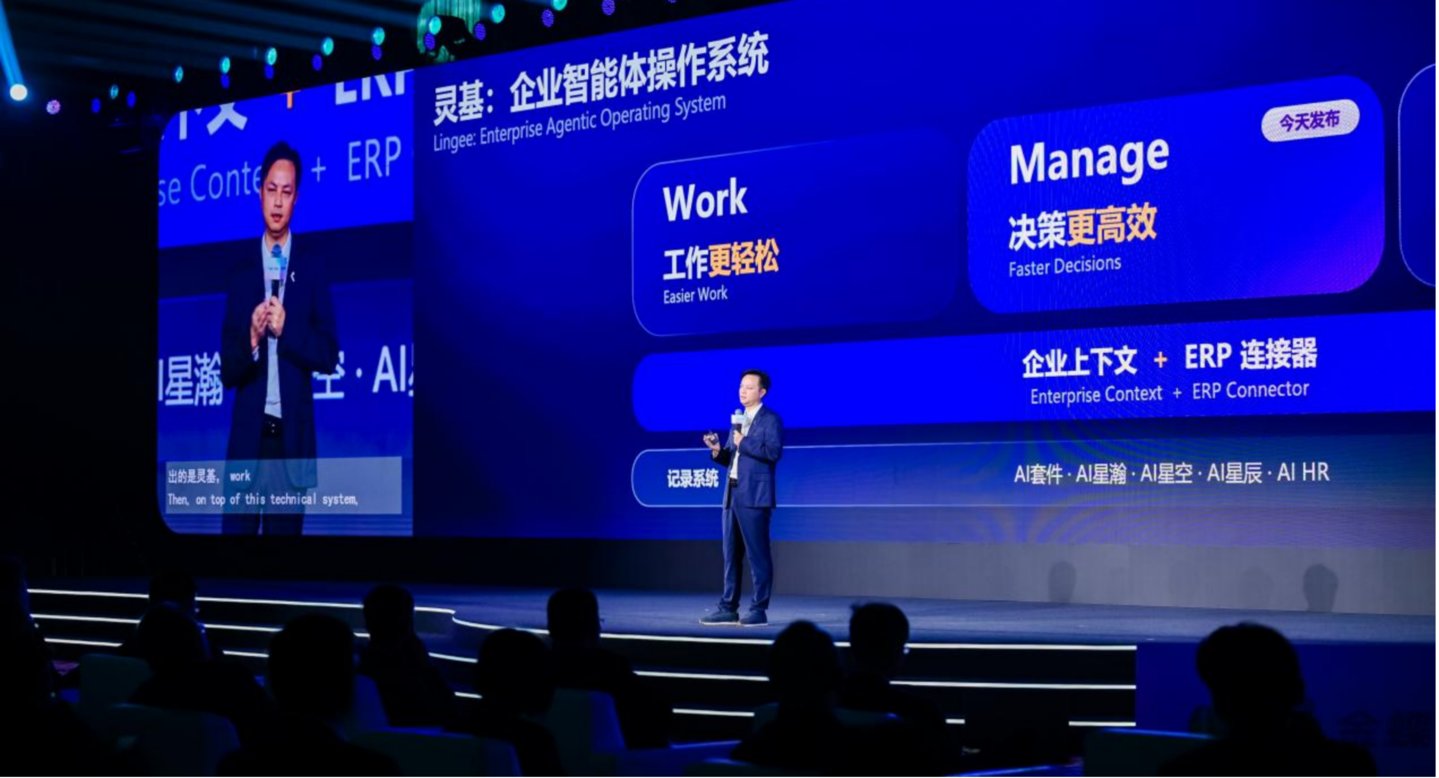
Liu Zhongwen said that in the past, like the ERP system, it can be understood as a recording system. In the AI native organization, if AI is to become the core productivity of the enterprise, people are responsible for key judgments and responsible for the results, they also need to build an action system on top of the recording system to record things, and the action system will push things down. There are Kingdee's AI suite in the recording system, as well as cloud ERP systems such as Xinghan, Xingqing, and Xingxing. On top of the recording system, there are original AI products such as Lingji Work, Lingji Manage, and Lingji Build.
To this end, Lingji's design ideas hope to bring further value to enterprises by giving full play to the capabilities that the original ERP system or SaaS system could not achieve through AI capabilities. And ERP is still a very important data and knowledge core asset for enterprises.
In order to schedule the connection with the original ERP system, Lingji is embedded on the home page of all ERP systems of Kingdee customers. Enterprise employees can see Lingji on the home page of the ERP system. In terms of use scenarios, although the initial and most accessible scenario is actually the enterprise data analysis scenario, that is, the data in the ERP system is queried, analyzed and attributed through Lingji, Kingdee believes that the customer has gone to the deep water area of the AI application scenario.
Liu Zhongwen pointed out that the most important core function of Lingji's ERP connector is to open up the ability to query data. In his view, combining a complex ERP system with an AI platform to allow it to work in its entirety is extremely complex. For example, during the exploration of integrating Lingji and Sky, Kingdee itself realized that it was difficult for external third-party platforms to do without the support of Sky's permission system, control system and context, and that query damage to customer systems was minimal.
In addition, in terms of context, Lingji upgraded the ERP from the recording system to the cognitive base of the Agent, allowing the Agent to work with the existing business logic and rules of the enterprise, rather than guessing from scratch. The upper limit of the Agent's capabilities does not depend entirely on the model itself, but on how much structured enterprise context it can get. The ERP system precipitates not only data, but also relationships between business objects, rules for approval circulation, permission boundaries, and historical processing habits, which are the basis for Agent inquiries, expressions, and actions.
For any new piece of software, it typically takes 12 to 18 months to transition from trial to running in a business-critical system. At first, many Agent products could not be promoted to enterprise scenarios on a large scale, and the product itself was still not perfect. Kingdee's response to Spirituality does not shy away from & ldquo; early & rdquo; Two words: product release is only five months, technically established, but the credibility of customer value, the boundaries of human-computer interaction, etc., also need to rely on engineering capabilities and customer verification to jointly promote.
Zhang Yong's judgment on the future is that a number of factors are superimposed, which together constitute Kingdee's new contracted customers' growth momentum: On the one hand, the SASAC has put forward a series of clear and interrelated requirements for central enterprises around the construction of penetrating supervision and DRP (global digital resource management platform); on the other hand, AI, as an important development engine of & ldquo; fifteen-five & rdquo; planning, is also continuously releasing policy and market dividends.