Why did the most profitable company persuade 60,000 people to leave voluntarily?
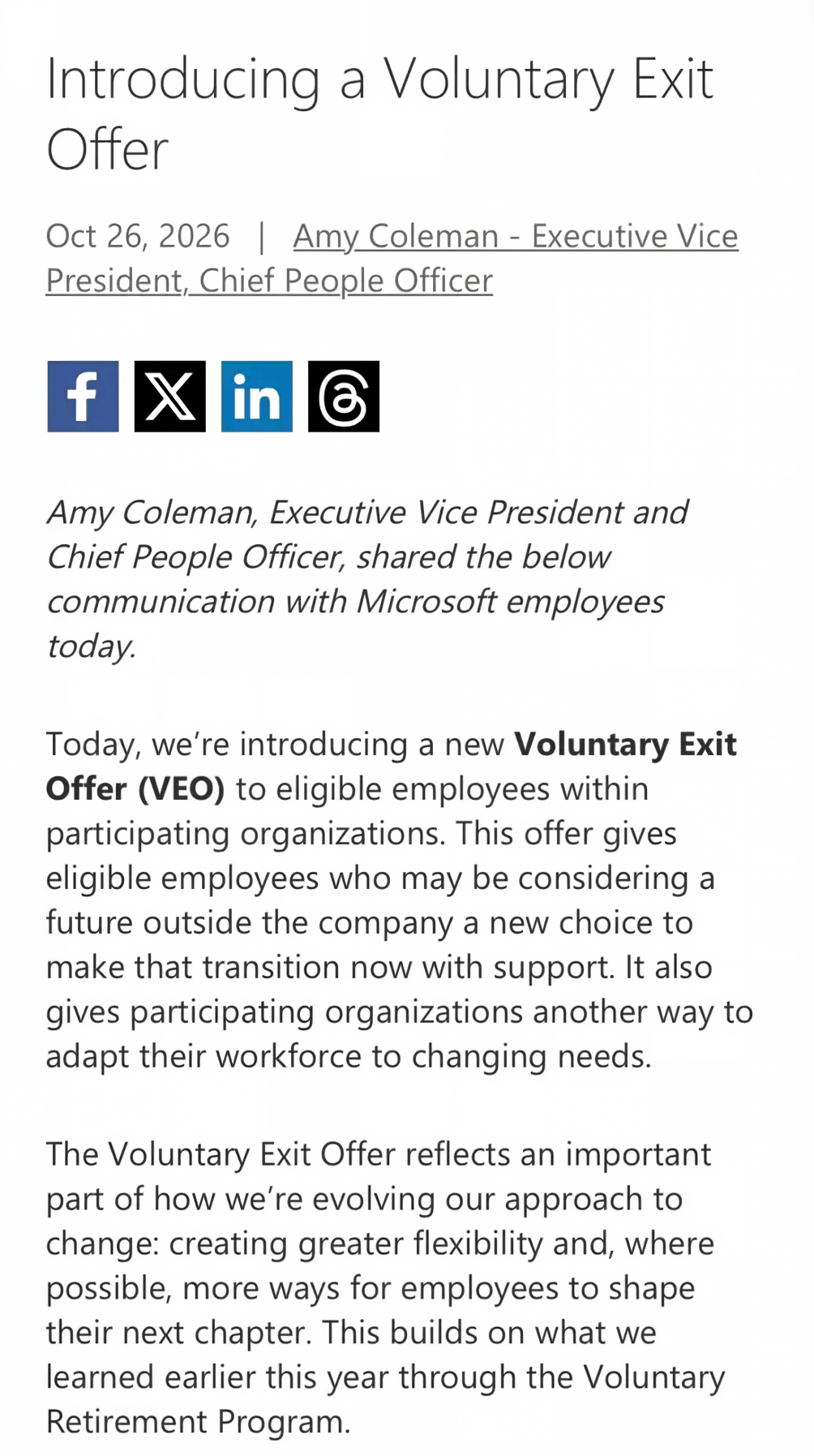
On October 26, Microsoft sent a special invitation to about 60,000 employees around the world: You can leave voluntarily, and the company will give you a compensation.
These 60,000 people account for approximately 27% of Microsoft’s global employees. Vice presidents and below are all eligible to apply.
This is not the first time Microsoft has adjusted its workforce. In April this year, it launched a voluntary retirement plan; in July, it laid off about 4,800 jobs.
But this time, the most dazzling thing is not the number, but one word - voluntary.
01
60,000 people left voluntarily. What conditions did Microsoft offer?
This plan is called VEO (Voluntary Exit Offer) and covers some teams in the United States, Canada, India, and the United Kingdom.
Microsoft made it very clear: This is a time-limited voluntary project, and eligible employees can choose to leave and receive financial compensation and career planning support.
Compensation is based on the company's standard severance plan - basic salary compensation calculated based on company age and rank, continued vesting of stocks, fixed-term medical insurance, and career transition services.
According to some U.S. employee plans disclosed by Business Insider: Employees with grade 64 and below will receive one week of basic salary for every half-year of service; employees with grades 65 to 67 will receive two weeks of basic salary for every half-year of service.
Employees need to make a decision by early December and officially leave before the end of the year.
Translated into the vernacular: go, go with dignity and with compensation; but the decision window is only one month.

As technology changes faster and faster, ordinary people's uneasiness becomes more concrete.
02
Microsoft is not short of money, so why is it trying to persuade people to leave?
Let’s look at Microsoft’s wallet first: In the last fiscal year (FY26), Microsoft’s revenue was approximately US$331.8 billion, and its net profit was approximately US$133.7 billion.
This is a very profitable company.
Where did the money go? One answer is becoming clear: AI.
In order to bet on AI, Microsoft has spent huge capital expenditures on computing power, data centers, and models; its investment in OpenAI also dragged down net profits of approximately US$3.1 billion in the last fiscal year.
On the one hand, there is a huge investment in AI, and on the other hand, profit margins must be supported - manpower has become the one item that can be recalculated.
A more fundamental change is: when AI can replace part of repetitive output, the company's requirements for human efficiency will change.
In the past, more people meant production capacity; now, companies hope to use fewer people and shorter processes to achieve the same output.
So this is not because Microsoft is short of money, but because Microsoft has recalculated: is the position of 60,000 people worth retaining?
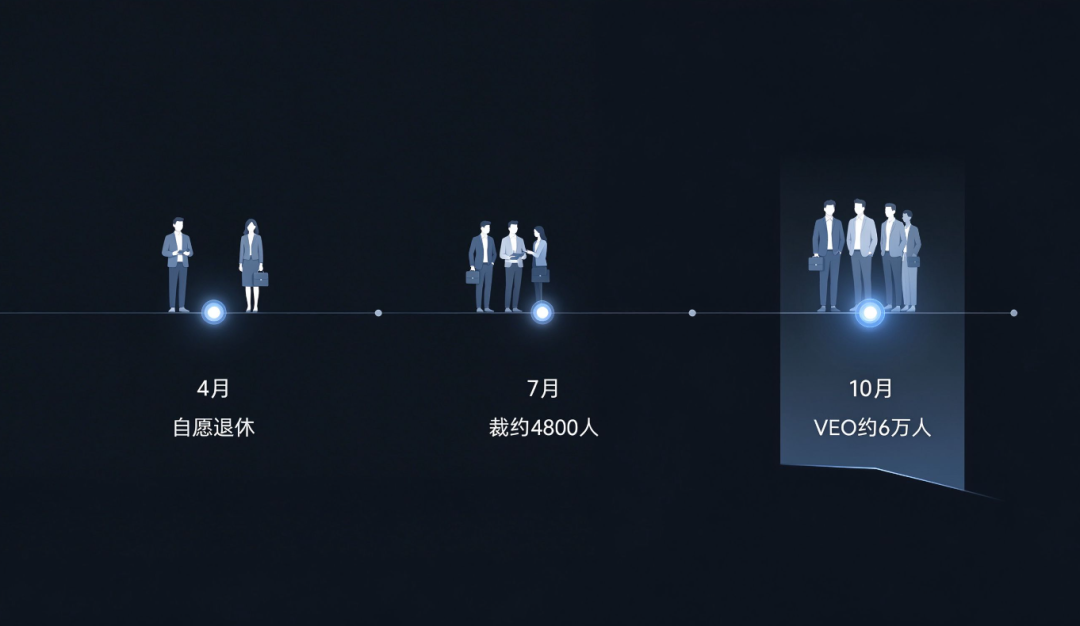
Microsoft's three rounds of personnel adjustments timeline this year
(Voluntary retirement in April, approximately 4,800 layoffs in July, approximately 60,000 VEOs in October)
03
Who is the word "voluntary" meant for?
Why is it called voluntary and not layoffs?
From a company perspective, the reasons are practical.
For employees: Voluntariness means dignity. They don’t have to face the confrontation and humiliation of forced layoffs. They get compensation and leave, which makes both parties better off.
To public opinion: Voluntary layoffs sound much milder than layoffs, and the headlines look better—you see, employees chose them themselves.
To Wall Street: This official announcement before the financial report sends the same signal - we are actively optimizing costs, and we are All in AI.
But voluntariness has boundaries: the scope is defined by the company (US, Canada, India, UK, level 70 and below), the time window is determined by the company (decided before the beginning of December), and the compensation standard is calculated by the company.
What employees can choose is to stay or stay within the framework.
The real choice is never in the hands of employees. This is probably the most subtle part of the word voluntary.
04
The calculation of 60,000 people, and the 270,000 people left behind
When this account falls on a specific person, the algorithm is completely different.
For older employees who are approaching retirement or already planning to leave: This may be early retirement with compensation, which is a good deal.
For young, low-level employees: the compensation is cash, but in exchange for a few months of job hunting - they have to calculate the opportunity cost.
To the top AI talents that Microsoft wants to retain: The signal sent by the company is clear - if you stay, we need you more.
In other words, VEO is like a mirror, showing who needs the job more.
But what really makes people in the workplace uneasy is another thing: Even the most profitable software company in the world is recalculating the price of people. Will the next company that recalculates this calculation be the one where I work?

05
Tomorrow’s financial report, what should we read?
Tomorrow (October 28), Microsoft will release its first quarter financial report of the new fiscal year.
At that time, it is worth looking at not only the revenue figures, but also three things: how much growth the AI business has contributed, whether capital expenditures will continue to soar, and whether profit margins have been suppressed by AI investment.
For ordinary workers, what is more worth remembering than financial report numbers is:
AI has not directly laid off anyone, but it is quietly rewriting the standards by which companies evaluate people.
When the price of people begins to be recalculated, what each of us can do may not be anxious about whether we will be replaced, but think clearly about what our irreplaceable abilities are in the face of AI.
#Microsoft #voluntary resignation #AI #AI与 Employment #大科技 Factory #WORKPLACE TRANSFORMATION #TALENT STRUCTURE ADJUSTMENT #Enterprise Cost Reduction and Efficiency Increase #AI Capital Expenditure #Industrial Digital